Top 100 Chart Placements
Updated 1 year ago
The remix album Gesamtklärwerk Deutschland is a collaborative art and music project by Jonathan Meese and DJ Hell. It combines electronic club music with conceptual art and motifs drawn from cultural theory. From an academic perspective, the project can be understood as an interdisciplinary intersection of pop culture, performance art, and electronic music studies. Remix structures here function in a way similar to how they are described in media studies: existing sonic and semantic structures are deconstructed, recombined, and placed into altered contexts. The "treatment plant" (Klärwerk) motif can be interpreted metaphorically as a process of cultural filtering or purification, in which historical narratives, ideologies, and pop symbols are reprocessed. From a historical standpoint, the project draws on several traditions: - the avant-garde strategies of the Dada and Fluxus movements, which employed collage, provocation, and irony - the German electronic music tradition since the 1970s (e.g., experimental studio work and concept albums) - the club and remix culture of the 1990s and 2000s, in which DJs use existing works as raw material for new aesthetic forms Thus, the album is understood less as a conventional music release and more as a comprehensive artistic concept that raises questions about German cultural history, pop mythologies, and the role of remix as a cultural method.
International DeeJay Gigolo Records Electro (Classic / Detroit / Modern)
The remix album Gesamtklärwerk Deutschland is a collaborative art and music project by Jonathan Meese and DJ Hell. It combines electronic club music with conceptual art and motifs drawn from cultural theory. From an academic perspective, the project can be understood as an interdisciplinary intersection of pop culture, performance art, and electronic music studies. Remix structures here function in a way similar to how they are described in media studies: existing sonic and semantic structures are deconstructed, recombined, and placed into altered contexts. The "treatment plant" (Klärwerk) motif can be interpreted metaphorically as a process of cultural filtering or purification, in which historical narratives, ideologies, and pop symbols are reprocessed. From a historical standpoint, the project draws on several traditions: - the avant-garde strategies of the Dada and Fluxus movements, which employed collage, provocation, and irony - the German electronic music tradition since the 1970s (e.g., experimental studio work and concept albums) - the club and remix culture of the 1990s and 2000s, in which DJs use existing works as raw material for new aesthetic forms Thus, the album is understood less as a conventional music release and more as a comprehensive artistic concept that raises questions about German cultural history, pop mythologies, and the role of remix as a cultural method.
International DeeJay Gigolo Records Electro (Classic / Detroit / Modern)
The remix album Gesamtklärwerk Deutschland is a collaborative art and music project by Jonathan Meese and DJ Hell. It combines electronic club music with conceptual art and motifs drawn from cultural theory. From an academic perspective, the project can be understood as an interdisciplinary intersection of pop culture, performance art, and electronic music studies. Remix structures here function in a way similar to how they are described in media studies: existing sonic and semantic structures are deconstructed, recombined, and placed into altered contexts. The "treatment plant" (Klärwerk) motif can be interpreted metaphorically as a process of cultural filtering or purification, in which historical narratives, ideologies, and pop symbols are reprocessed. From a historical standpoint, the project draws on several traditions: - the avant-garde strategies of the Dada and Fluxus movements, which employed collage, provocation, and irony - the German electronic music tradition since the 1970s (e.g., experimental studio work and concept albums) - the club and remix culture of the 1990s and 2000s, in which DJs use existing works as raw material for new aesthetic forms Thus, the album is understood less as a conventional music release and more as a comprehensive artistic concept that raises questions about German cultural history, pop mythologies, and the role of remix as a cultural method.
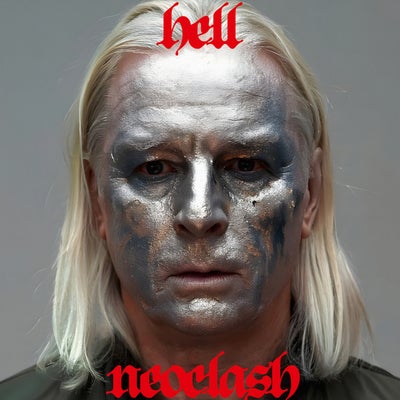
NEOCLASH is DJ Hell's new work. The Electroclash of the early 2000s is reconstructed here, its characteristic codes extracted and reshaped into a modern, reflective form. NEOCLASH is a cultural experiment - music as a medium of reflection, a structure for space and time, and a vehicle for exploring the tensions between technology, the body, and perception. Electroclash now - or a manifesto for the aesthetic relevance of electronic club music, combining strong old-school references with a new understanding. DJ Hell, a.k.a. Helmut Josef Geier, delivers a contemporary reinterpretation of the Electroclash genre. International Deejay Gigolo Records was the pulse of the movement 25 years ago - and Hell, its very namesake. Godfather of Electroclash reloaded. 25 years and many milestones later, DJ Hell returns to his roots with NEOCLASH, proving that Electroclash in 2025 can sound not nostalgic, but forward-thinking and visionary. NEOCLASH builds a bridge between past and present within electronic dance culture and club music. Italo Disco, New Wave, Indie Dance, Disco, Pop, Chicago House, Acid, Detroit Techno, and Avantgarde Music merge here into a bold new interpretation.